
ACL Reconstruction
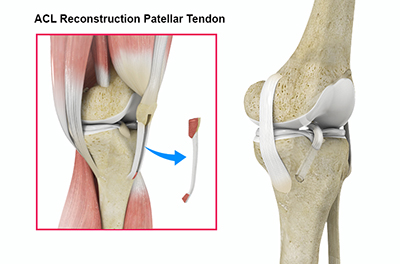
What is ACL Reconstruction Surgery?
The anterior cruciate ligament (ACL) is one of the four major ligaments of the knee that connects the femur (thighbone) to the tibia (shinbone) and helps stabilize the knee joint. The anterior cruciate ligament prevents excessive forward movement of the lower leg bone (tibia) in relation to the thighbone (femur), as well as limits rotational movements of the knee.
A tear of this ligament can make you feel as though your knees will not allow you to move or even hold you up. Anterior cruciate ligament reconstruction is surgery to reconstruct the torn ligament of your knee with a graft.

Indications
Tearing of the ACL is the indication for an ACL reconstruction. An ACL injury most commonly occurs during sports activities that involve twisting or overextending of your knee. An ACL can be injured in several ways:
- Sudden directional change
- Slowing down while running
- Landing from a jump incorrectly
- Direct trauma to the side of your knee, such as during a football tackle
When you injure your ACL, you might hear a loud "pop" sound and may feel the knee buckle. You may notice that the knee feels unstable or seems to give way, especially when trying to change direction. If you have these symptoms and it is affecting your quality of life, you may want to see an orthopedic surgeon for a full evaluation.
Description of Surgery
The procedure is performed under general anesthesia.
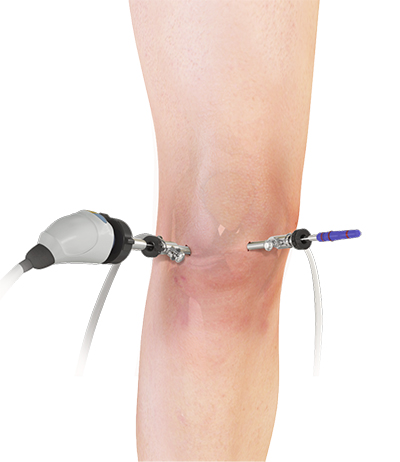
An arthroscope, a tube with a small video camera on the end is inserted through one incision to see the inside of the knee joint. Along with the arthroscope, a sterile solution is pumped into the knee to expand it, providing your surgeon with a clear view of the inside of the joint.
The torn ACL will be removed and the pathway for the new ACL is prepared. The arthroscope is inserted into the knee joint through one of the small incisions. Small tunnels are created in the upper and lower leg bones (tibia and femur) at the knee joint to accept the new ACL graft. The graft is inserted through these tunnels and then fixed into the bone with screws or buttons to hold it in place while the ligament heals into the bone.