
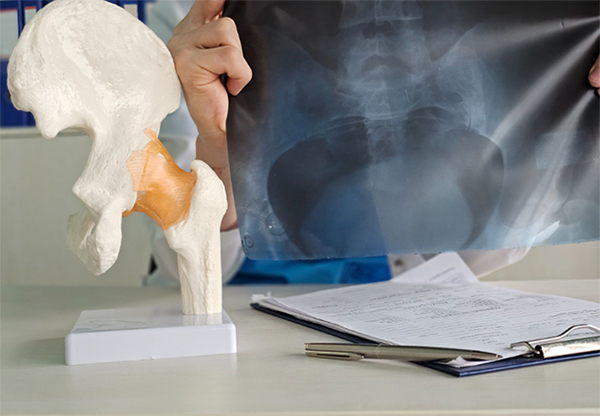
Your imaging study could reveal a significant labral tear in your hip that has caused little more than occasional stiffness, or you could be experiencing debilitating groin pain while initial imaging appears unremarkable. This disconnect between symptoms and actual joint damage can pose a challenge in diagnosing hip conditions. Here is what patients navigating hip pain need to know.
What the Labrum Does and Why It Matters
The acetabular labrum is a ring of fibrocartilage lining the rim of the hip socket. It creates a negative pressure seal that stabilizes the femoral head, distributes mechanical load across the joint, regulates synovial fluid, and protects articular cartilage from abnormal stress. When intact, these functions operate silently. When torn, the consequences can extend well beyond the tear itself, though the timeline and severity vary enormously from patient to patient.
Why Labral Tears Are Sometimes Asymptomatic
Labral tears are far more common than symptoms alone would suggest. Research has identified tears in a significant proportion of asymptomatic hips, particularly in patients with underlying femoroacetabular impingement (FAI).1 The labrum has a relatively poor blood supply, concentrated at its base near the acetabular rim. This limited vascularity means tears, particularly in the inner, avascular portion, may not generate the inflammatory response typically associated with pain. A tear can exist, grow, and alter joint mechanics for years before producing recognizable symptoms.
The Mismatch Between Imaging and Pain
Even when a labral tear is identified on MRI, structural damage does not reliably predict pain levels. Nerve distribution within the labrum is uneven; tears in less innervated regions may be mechanically significant but clinically silent. Pain perception is further influenced by central sensitization, activity level, and individual pain thresholds. Two patients with structurally identical tears can present with entirely different clinical pictures, which is why symptoms alone are an unreliable guide to the urgency of treatment.
The Problem With Waiting for Pain to Guide Treatment
The absence of significant pain does not mean the joint is stable or protected. A torn labrum disrupts the hip's pressure seal, redistributes load unevenly across the cartilage, and accelerates the cartilage breakdown that leads to osteoarthritis. Cartilage has no meaningful capacity for self-repair. Once lost, it cannot be regenerated through natural healing. This creates a critical paradox: the window for joint-preserving intervention is widest precisely when symptoms are most easily dismissed. Patients who wait until pain becomes severe may do so at the cost of cartilage that could have been protected.
How Hip Labral Damage Progresses and What Drives It
Labral tears rarely remain static. Untreated, they trigger a series of changes; altered fluid dynamics increase stress on adjacent cartilage, and the chondrolabral junction becomes progressively more vulnerable. Early focal cartilage lesions develop silently, often at the same location as the tear, and expand over time. In most cases, labral tears are the consequence of an underlying structural problem that creates repetitive mechanical stress. Identifying and correcting the structural cause is as important as treating the tear itself. Without addressing the underlying mechanics, even a well-repaired labrum faces the same forces that originally caused it to fail.
Why Early Evaluation Changes Outcomes
Because the relationship between symptoms and damage is so unreliable, evaluation must go beyond pain assessment. MRI arthrogram is essential for accurately characterizing tear morphology and associated cartilage involvement. When tears are identified early, before significant cartilage loss, labral repair or reconstruction combined with correction of the underlying structural cause offers the best opportunity for long-term joint preservation. The goal is not simply to relieve current symptoms. It is to interrupt a progression that, left unrecognized, leads silently toward arthritis.
FAQs
- Can a labral tear heal on its own?
No, the labrum has limited blood supply, so most tears do not heal without treatment. - Why do some labral tears cause no pain?
Certain areas of the labrum have fewer nerve endings, meaning damage can exist without triggering noticeable symptoms. - What activities can worsen a labral tear?
Repetitive movements like twisting, pivoting, deep squatting, or prolonged sitting can increase stress on the labrum. - How are labral tears accurately diagnosed?
An MRI arthrogram is the most effective imaging test to detect labral tears and assess associated cartilage damage. - When should I see a specialist for a possible labral tear?
If you have persistent hip stiffness, clicking, or activity-related discomfort, early evaluation can help prevent further joint damage.
Reference Links: