
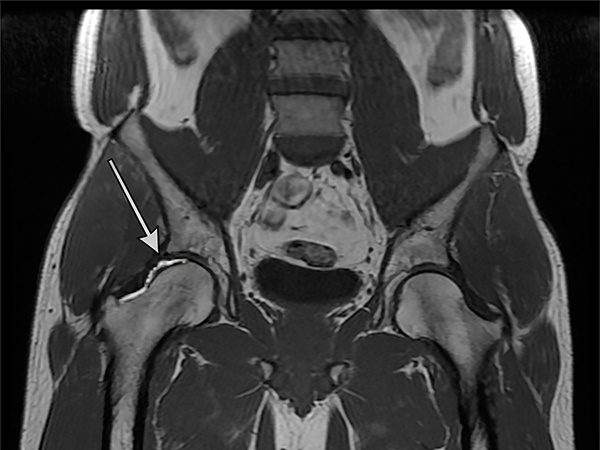
A hip MRI can provide valuable information about a labral tear, but the size or description of a tear on a radiology report does not always tell the whole story. A report describing a "small" tear does not necessarily mean that the underlying hip problem is minor, particularly when symptoms include persistent groin pain, clicking, catching, or difficulty with everyday activities. Understanding the imaging findings in the context of the patient's symptoms, physical examination, and overall hip anatomy is essential when determining what is actually causing the pain.
What Does an MRI Show in a Hip Labral Tear?
The acetabular labrum is a ring of fibrocartilage that surrounds the hip socket. It helps deepen the socket, contributes to joint stability, and helps maintain the fluid seal within the hip joint. When the labrum becomes torn, patients may experience groin pain, clicking, catching, stiffness, or pain with certain movements.
MRI can provide detailed images of the labrum and other structures within and around the hip. However, MRI is still an imaging study rather than a direct examination of the joint. The images represent a series of static slices, and the appearance of a labral tear can vary depending on its location, orientation, size, and associated pathology.
A report that describes a tear as "small" therefore should not be interpreted in isolation. The clinical significance of a labral tear depends on more than its measured length.
Why Can a Labral Tear Appear Smaller on Imaging?
The hip labrum is a three-dimensional structure, while MRI images are obtained in specific planes. A tear that extends through multiple regions of the labrum may not be completely appreciated on every sequence or plane.
The way a tear is described can also vary between radiologists and surgeons. One reader may describe a focal tear, while another may recognize a more extensive pattern of detachment or degeneration when reviewing the same study alongside the patient's examination and other imaging.
The labrum may also have associated abnormalities that are more important than the length of the tear itself. Damage to the cartilage, inflammation within the joint, abnormalities in the shape of the femoral head and socket, or instability can all influence how a patient experiences a labral injury.
The Size of a Labral Tear Does Not Always Predict Pain
It is easy to assume that a larger tear must cause more pain and a smaller tear must cause less. The relationship is not that simple.
Some patients have labral abnormalities on imaging without significant symptoms. Others can have relatively subtle imaging findings but substantial pain and mechanical symptoms. This is one reason physicians should not diagnose or treat a labral tear based solely on the MRI report.
The underlying cause of the labral injury also matters. A labral tear associated with femoroacetabular impingement, for example, may continue to be exposed to abnormal forces if the underlying bony morphology is not addressed. A tear associated with dysplasia or instability may have an entirely different mechanical environment.
The question is therefore not simply, "How big is the tear?" It is also, "Why did the labrum tear, and what else is happening in the hip?"
What Other Hip Problems Can Exist Alongside a Labral Tear?
A labral tear is sometimes only one part of a larger hip problem. Femoroacetabular impingement, hip dysplasia, cartilage damage, hip instability, and abnormalities in femoral or acetabular version can all influence the mechanics of the joint.
For example, femoroacetabular impingement can cause repetitive contact between the femur and acetabulum, potentially damaging the labrum and cartilage over time. In a hip with dysplasia, inadequate coverage of the femoral head can place additional stress on the labrum as it helps stabilize the joint.
This is why a comprehensive hip evaluation looks beyond the words "labral tear" on an MRI report. The goal is to identify the underlying mechanical or biological reason the labrum became symptomatic in the first place.
When Symptoms and Imaging Do Not Match
A discrepancy between imaging and symptoms does not necessarily mean that either the patient or the MRI is wrong. It means the entire clinical picture needs to be considered.
A patient with persistent groin pain, clicking, catching, restricted motion, or pain during specific activities may warrant further evaluation even if the MRI describes only a small tear. A physician may review the original images rather than relying solely on the written report and may consider X-rays, MRI arthrography, CT imaging, or diagnostic injections depending on the circumstances.
A diagnostic injection can sometimes help determine whether pain is actually originating from inside the hip joint. When symptoms, examination findings, and imaging are considered together, physicians can develop a much clearer understanding of what is driving the patient's symptoms.
The Bigger Picture
A "small" labral tear on an MRI does not automatically mean a small hip problem. Imaging provides important information, but it is only one part of the diagnostic process. The location and character of the tear, the condition of the cartilage, the shape and coverage of the hip joint, and the patient's symptoms all matter.
If your symptoms seem significantly worse than the findings described on your MRI, that does not mean your pain is imagined or insignificant. A comprehensive evaluation by a hip specialist can help determine whether the labral tear is truly the source of your symptoms and whether another underlying condition is contributing to the problem.
Frequently Asked Questions
- Can an MRI underestimate the size of a hip labral tear?
Yes. MRI provides static images of a three-dimensional structure, and the full extent or pattern of a labral injury may not always be completely characterized on the initial study. - Does a small labral tear mean my hip pain should be mild?
No. The size of a tear does not necessarily correlate directly with the severity of symptoms. The location of the tear and other conditions affecting the hip can also influence pain. - What can cause a hip labral tear?
Labral tears can develop from repetitive stress, femoroacetabular impingement, hip dysplasia, instability, trauma, or age-related degeneration. - What if my MRI shows a labral tear but my pain is severe?
A comprehensive evaluation can help determine whether the tear is responsible for the symptoms and whether another condition, such as impingement, dysplasia, cartilage damage, or instability, is also present. - Can a hip labral tear be treated without surgery?
Depending on the cause and severity of symptoms, treatment may include activity modification, physical therapy, medications, or injections. Some patients with persistent symptoms may ultimately be candidates for hip arthroscopy or another procedure.