

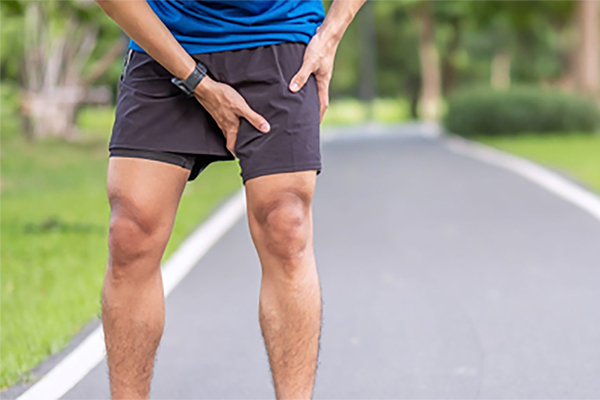
You felt it during a sprint, a kick, or a sudden change of direction, and now there is a nagging ache somewhere in the front of your hip or inner thigh that won't fully go away. You Google the symptoms and land on two possible answers: groin strain or hip flexor injury. Both sound plausible. Both hurt in roughly the same neighborhood. But they are not the same thing. They don't always respond to the same treatment, and confusing one for the other is one of the more common reasons athletes stay hurt longer than necessary.
What Causes Groin Pain and Hip Flexor Pain?
The groin and the hip flexor share real estate so close together that it's understandable why patients and even clinicians can initially struggle to separate them. Groin pain in athletes most commonly involves the adductor muscles, the group that pulls the thigh inward, along with their tendons and attachments at the pubic bone. Hip flexor pain, by contrast, typically originates in the iliopsoas, the deep muscle running from the lumbar spine through the pelvis to the inner upper thigh, which is responsible for lifting the knee toward the chest. Both structures converge near the front of the hip, and both can produce pain that feels centered somewhere between the inner thigh and the lower abdomen depending on what is irritated and how severely.
Where Do You Feel Groin Pain vs. Hip Flexor Pain?
Location is the first meaningful clue. Adductor-related groin pain tends to concentrate around the inner thigh and the attachment of the adductor longus tendon at the pubic bone, and it can radiate downward along the medial thigh. Squeezing the knees together against resistance typically reproduces it, as does stretching the inner thigh by moving the leg outward. Hip flexor pain, or iliopsoas-related groin pain as it is classified in clinical literature, tends to sit more anteriorly, in the front of the hip and upper thigh rather than the inner thigh, and is more laterally positioned than the deep inner ache of an adductor problem. It is usually reproduced by resisted hip flexion, meaning pushing the knee upward against resistance, or by stretching the hip into extension.
The Movement That Caused the Pain Matters
The mechanism of injury offers another layer of distinction. Adductor strains most commonly occur during kicking motions and rapid change of direction, where the inner thigh muscles are loaded while the leg is abducted. They are a signature injury of soccer, hockey, and rugby for exactly this reason. Iliopsoas injuries, by contrast, more typically develop during movements that require change of direction as well, but the loading pattern is different, involving the hip flexing forcefully or eccentrically decelerating from an extended position. Runners and dancers frequently develop iliopsoas-related pain as an overuse pattern rather than a single acute event, which distinguishes it from the more acute presentation of an adductor strain that occurs during a single forceful movement.
Can Groin Pain and Hip Flexor Pain Occur Together?
One of the clinically inconvenient realities of groin and hip flexor pain is that they can coexist and reinforce each other. The adductors also function as secondary hip flexors, which means that resisted hip flexion testing can reproduce adductor pain even when the iliopsoas is not the primary problem. Isolated iliopsoas injury is actually less common than it might seem. Research from the Physio Network notes that isolated hip flexor injury is unusual and that its presence should prompt consideration of an underlying primary problem, such as a stress reaction, joint pathology, or a labral tear that is contributing to secondary muscle guarding. This is a meaningful clinical point for anyone managing persistent groin or hip flexor pain that does not respond to straightforward soft tissue treatment.
When the Hip Joint Itself Is the Actual Source of the Pain
A layer that neither label captures is hip joint pathology, specifically femoroacetabular impingement and labral tears, which can produce deep anterior hip and groin pain that mimics both adductor and iliopsoas injury patterns. The clinical research literature on groin pain in athletes specifically includes hip-related groin pain as its own category under the Doha Agreement classification, recognizing that the joint itself is a distinct and important source of anterior hip and groin symptoms.1 AHI's own clinical focus on intra-articular hip conditions and labral pathology is particularly relevant here, since patients who have been treated for a recurring groin or hip flexor strain without lasting improvement deserve a closer look at whether the hip joint is contributing to the symptom pattern rather than the muscles alone.
How Do Doctors Diagnose Groin and Hip Flexor Injuries?
The practical implication of all of this is that self-diagnosing groin or hip flexor pain based on location alone is unreliable, and treating it without a proper evaluation often means addressing the wrong structure. A thorough clinical assessment that includes provocative testing of the adductors, iliopsoas, pubic symphysis, and hip joint, supported by imaging when the picture is unclear, is what separates a precise, targeted treatment plan from one that keeps addressing the symptom without finding the source.
If groin or hip pain has been recurring despite rest and stretching, getting a proper evaluation is the clearest way to find out what is actually driving it.
Frequently Asked Questions
- How do I know if I have a groin strain or a hip flexor strain?
Groin strains typically cause pain at the inner thigh and pubic bone that worsens with squeezing the legs together or stretching the inner thigh, while hip flexor strains cause more anterior hip pain that worsens with lifting the knee against resistance or stretching the hip into extension. - Can groin pain and hip flexor pain happen at the same time?
Yes. The two conditions can coexist because the adductor muscles also function as secondary hip flexors, which means both structures can be irritated together, and clinical testing that reproduces pain with hip flexion does not always confirm that the iliopsoas is the primary problem. - What sports cause groin and hip flexor injuries most often?
Adductor-related groin injuries are most common in soccer, hockey, and rugby due to kicking and change-of-direction demands, while iliopsoas injuries are more frequent in runners, dancers, and athletes whose sport involves repeated forceful hip flexion. - Could my groin pain actually be coming from the hip joint itself?
Yes. Femoroacetabular impingement and labral tears can produce deep anterior hip and groin pain that closely resembles both adductor and hip flexor injuries, which is one reason recurring groin pain that does not respond to soft tissue treatment deserves a hip joint evaluation. - When should I see a doctor for groin or hip flexor pain?
Pain that does not improve within one to two weeks of rest and activity modification, pain that recurs repeatedly with return to sport, or pain accompanied by clicking, catching, or a sense of instability in the hip all warrant a clinical evaluation rather than continued self-management.
Reference Links: